

Have you ever looked at your partner and thought, “If they would just stop doing THAT, we’d be fine”?
Maybe you feel like you’re carrying the whole relationship. Maybe you feel like you’re walking on eggshells in your own house. Maybe you keep having the same fight over and over, and you can explain exactly why you react the way you do. There’s history. There’s a pattern. You have evidence.
The frustrating part? So does your partner.
That’s what we dug into on this week’s episode of Love Shack Live. And I’ll be honest, this one made all three of us squirm a little.
A couple who are both right
Picture a couple who’ve been frustrated with each other for months.
She feels like she’s carrying too much. She remembers the plans, follows up on things they already talked about, and keeps asking for things she wishes he’d just notice. And sometimes he really is being inconsiderate. He forgets things. He assumes she’ll work around his schedule.
He has his own experience. Lately it feels like whatever he does is wrong. He walks through the door and can feel that she’s annoyed with him. One mistake turns into a conversation about five other things he’s done wrong. So he starts pulling away. He stays at work a little later. He spends more time in another room. And yes, he really is withdrawing.
Then one night he says he’ll pick up dinner on his way home. Work runs late, and he forgets.
She’s furious, and it isn’t really about dinner. It’s every other time she felt like she had to keep track of everything. So she says, “Of course you forgot.”
He hears, “Here we go again. Nothing I do is good enough.” So instead of “You’re right, I said I’d do it and I forgot,” he says, “Why does everything have to be such a huge deal with you?”
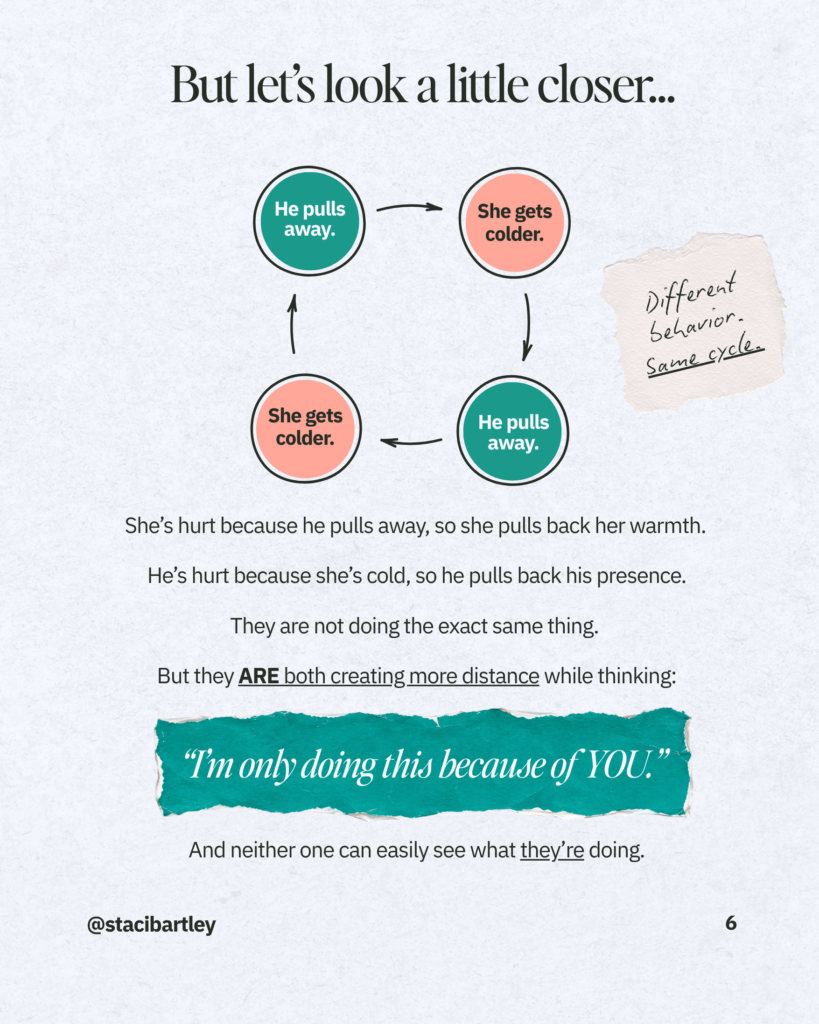
They both walk away thinking they just proved their point. She gets colder. He pulls farther away. And each of them is thinking the same thing: I’m only doing this because of you.
Why you can see their part so much more easily than your own
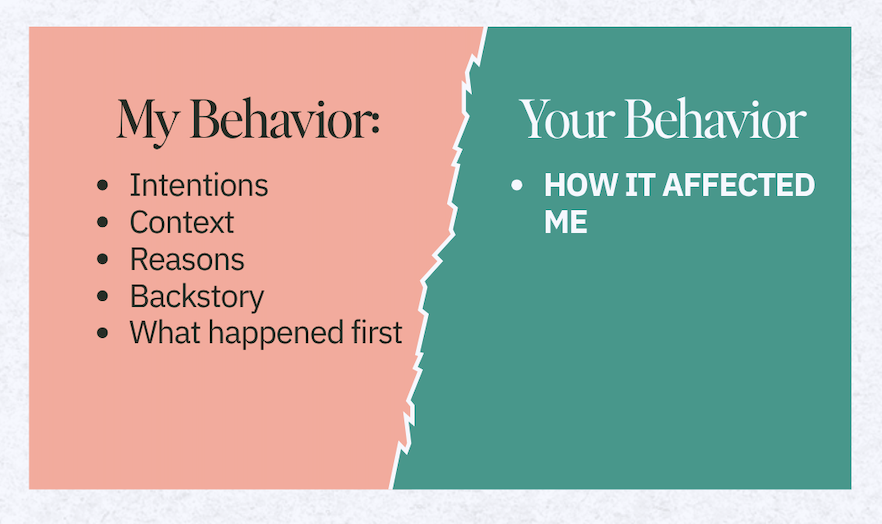
On the show, Brooke shared a simple visual that I haven’t stopped thinking about.
When it’s your behavior, you have all the information. Your intentions. The context. Your reasons. The backstory. What happened first.
When it’s your partner’s behavior, you mostly have one thing: how it affected you.
I talk a lot about the Internal Movie, the story that plays in each of our heads about what’s happening. This is why your movie always makes sense to you. You’ve seen the whole thing. Your partner has only seen the scenes where you went quiet or walked out of the room. And you’ve only seen theirs.
So she can easily see, “He keeps pulling away from me.” It’s much harder for her to notice, “I’ve been pulling away from him too. Mine just looks different.” And he’s probably missing the same thing on his side.
You can be completely right about what your partner is doing and still have something on your side worth looking at.
Remember that old saying?
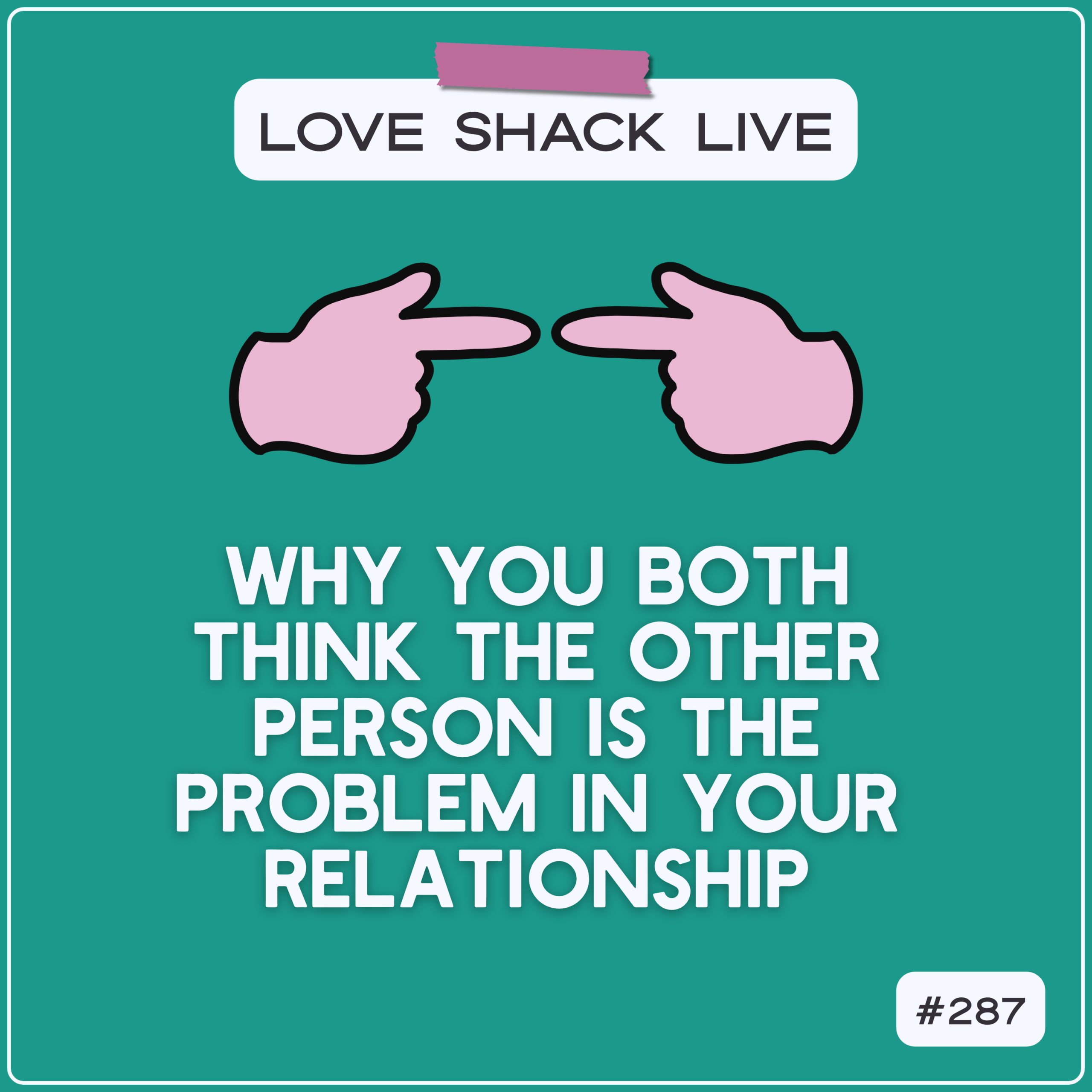
When you point a finger at someone, the rest of your fingers are pointing back at you.
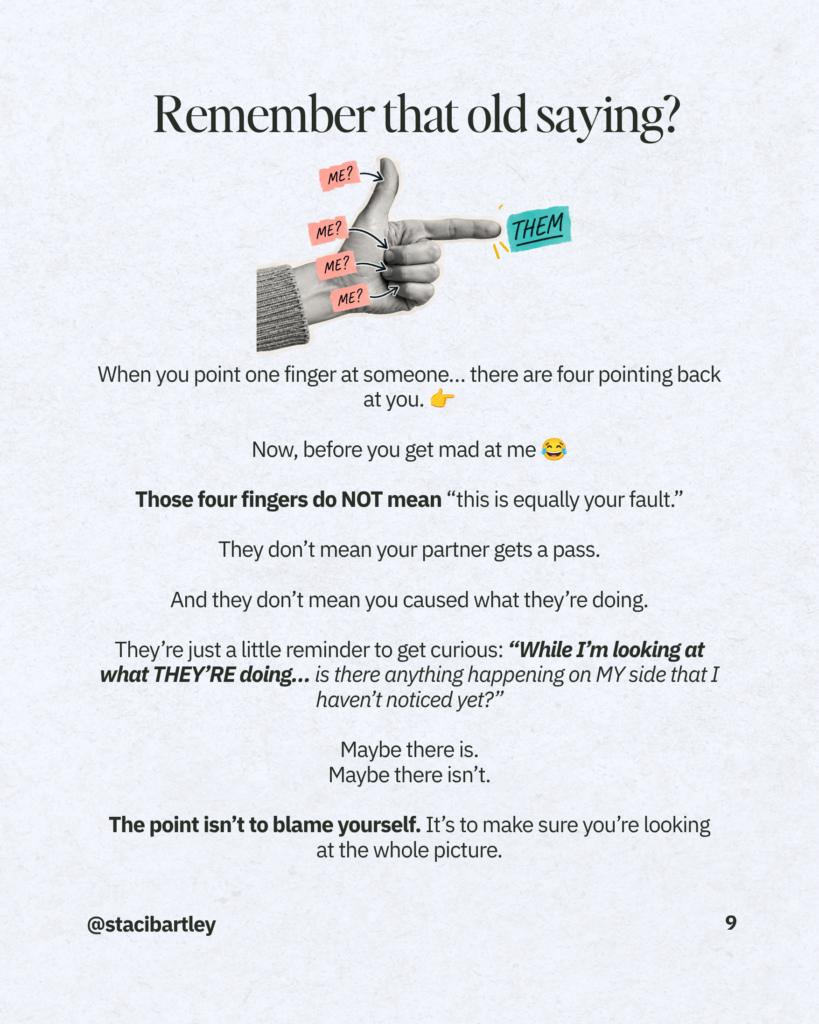
Before you get mad at me, that does NOT mean it’s equally your fault. It doesn’t mean your partner gets a pass, and it doesn’t mean you caused what they’re doing. It’s just a reminder to get curious: “While I’m looking at what they’re doing, is there anything happening on my side I haven’t noticed yet?”
Maybe there is. Maybe there isn’t. The point isn’t to blame yourself. It’s to see the whole picture.
Similar isn’t the same as equal
This is the part people miss, and it matters a lot.
Seeing a similarity tells you there may be something happening on both sides. It doesn’t tell you how often each person does it, how much it hurts, who’s owning it, or who’s actually working on changing it. Maybe one person does it way more. Maybe one person started doing it years before the other.
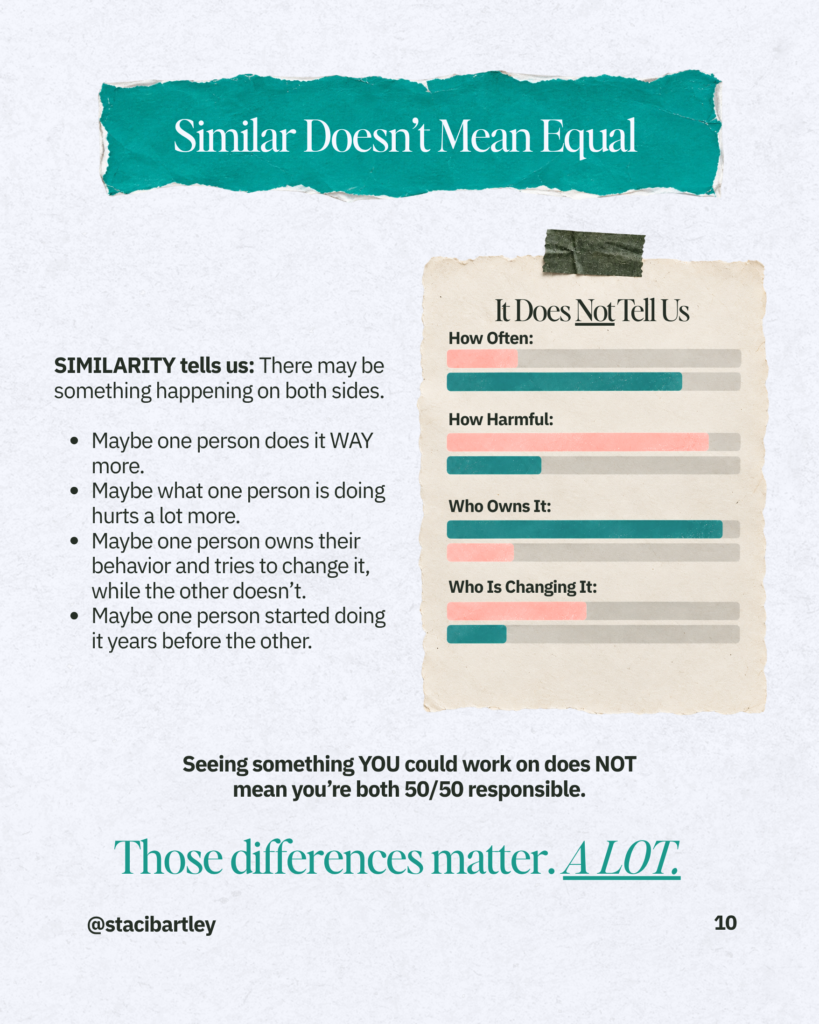
Seeing something you could work on does not make you 50/50 responsible. Those differences matter.
The contest nobody wins
Here’s what often happens when a couple finally realizes they’re both creating distance. They start competing.
“Okay, but you do it way more!”
“Mine isn’t nearly as bad as yours!”
“I only do it because I’m responding to you!”
Now they’re arguing over who’s doing the same thing worse. They’re still looking at each other instead of at the pattern. And underneath it all, they’re both saying the same two words: you first.
She’s thinking, “You stop pulling away, then maybe I’ll be warmer.” He’s thinking, “You stop being so cold, then maybe I’ll want to be around you.” Each of them is waiting for the other to change before they change their own response.
Why their side feels so threatening
When you’re already hurt, hearing your partner’s side can feel like it cancels yours out. Like if their experience is real, yours must not be.
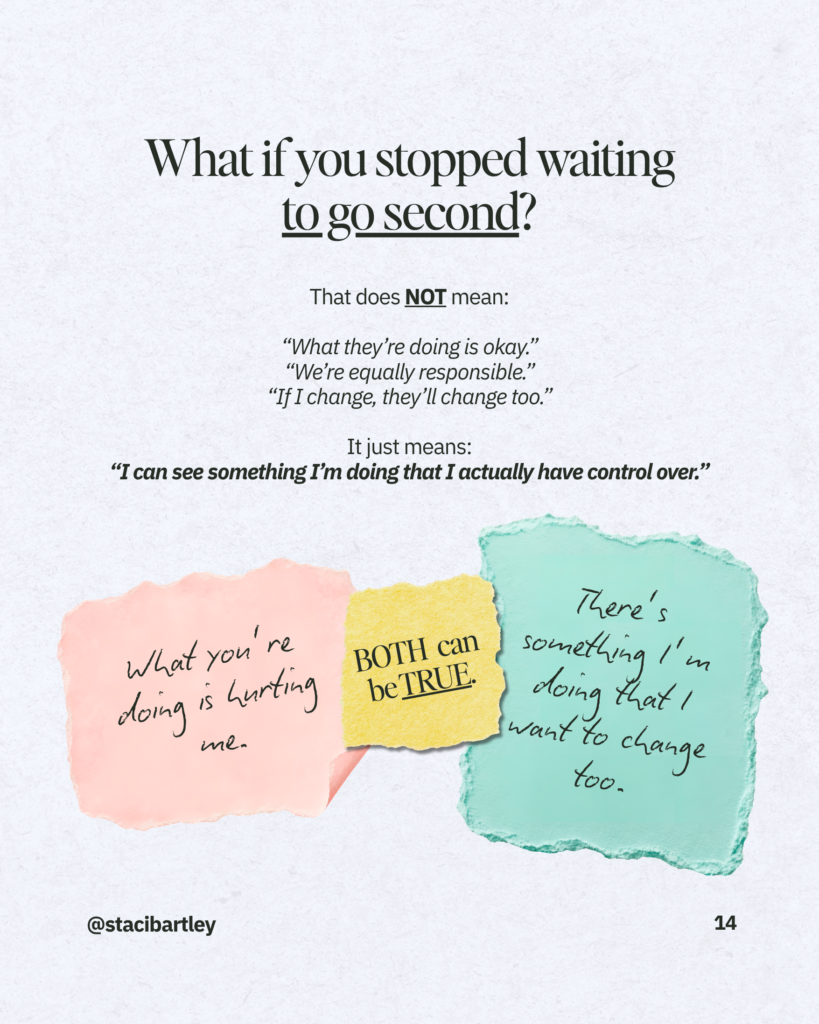
It doesn’t work that way. Two people can live in the same relationship and experience it very differently, and both experiences can be true. “What you’re doing is hurting me” and “There’s something I’m doing that I want to change too” can sit side by side.
If you notice you can’t hear your partner’s experience without immediately explaining, correcting or defending your own, you’re not alone. We’ve done a lot of episodes on defensiveness, and I’ve listed some of our favorites in the show notes.
What’s mine, what’s theirs, and what are we creating together?
This is where we landed on the show. When things get tangled, try separating three things.
What’s mine? The part I can actually see and actually change.
What’s theirs? Their part. I can name it and ask for something different, but I can’t do it for them.
What are we creating together? The pattern. The dance neither of us would choose on our own.
Taking responsibility for your part does not mean taking responsibility for theirs. It doesn’t mean they were right. It doesn’t mean you caused their behavior. And it doesn’t mean you can fix the relationship by yourself. It means you can finally see something on your side that you couldn’t see before, and now you have something you can actually work with.
What going first sounds like
Going first isn’t losing. For our couple, it might sound like this.
She could say: “I’ve gotten cold with you, and I don’t like who I’m being. I miss you.”
Or he could say: “I’ve been pulling away instead of talking to you. And I’m sorry I forgot dinner.”
It won’t fix everything, and it doesn’t make it 50/50. But for the first time in months, one of them is looking at the pattern instead of at each other.
Tom and I share a few stories of our own on the show about how hard this is to see when you’re living inside it. Yes, including the return of the infamous alarm clock fight. I’ll let you hear that one for yourself.
Check out the full carousel here: https://www.instagram.com/p/Dd9MBf6Ea-Q/?img_index=1
An important note
Everything here is meant for relationships where both people can safely take part in reflection and repair. It is not for abuse, coercive control, intimidation, threats or ongoing harm. No one is responsible for another person choosing to abuse or control them. If that’s happening in your relationship, please reach out to the National Domestic Violence Hotline at 1-800-799-7233, or text START to 88788.
Not sure what’s yours, what’s theirs, and what keeps happening between you?
The free Better Love Quiz looks at four relationship skill areas and shows you if this is a rough patch or something more, and where to start. It takes about 5 minutes: BetterLoveQuiz.com
And if you’ve been quietly wondering whether your relationship is actually in trouble, Is My Marriage Dead? will help you figure out what you’re looking at. It won’t tell you to stay or leave. It’s a $9 digital guide you can start reading tonight: https://stacibartley.mysamcart.com/is-your-marriage-dead