

If you love someone with avoidant attachment, or if you carry it yourself, this reframe changes everything about what listening actually means.
If you’ve ever been in a relationship shaped by avoidant and anxious attachment styles, you know the painful loop it creates. The avoidant partner goes quiet. Pulls back. Shuts down when things get intense. The anxious partner leans in harder, panics, needs reassurance right now, which pushes the avoidant partner further away, which heightens the anxiety, which increases the pursuit, which triggers more shutdown.
Round and round. Both people exhausted. Neither one winning.
Most relationship advice focuses on what to say in these moments. Better scripts. Kinder words. Less blaming language.
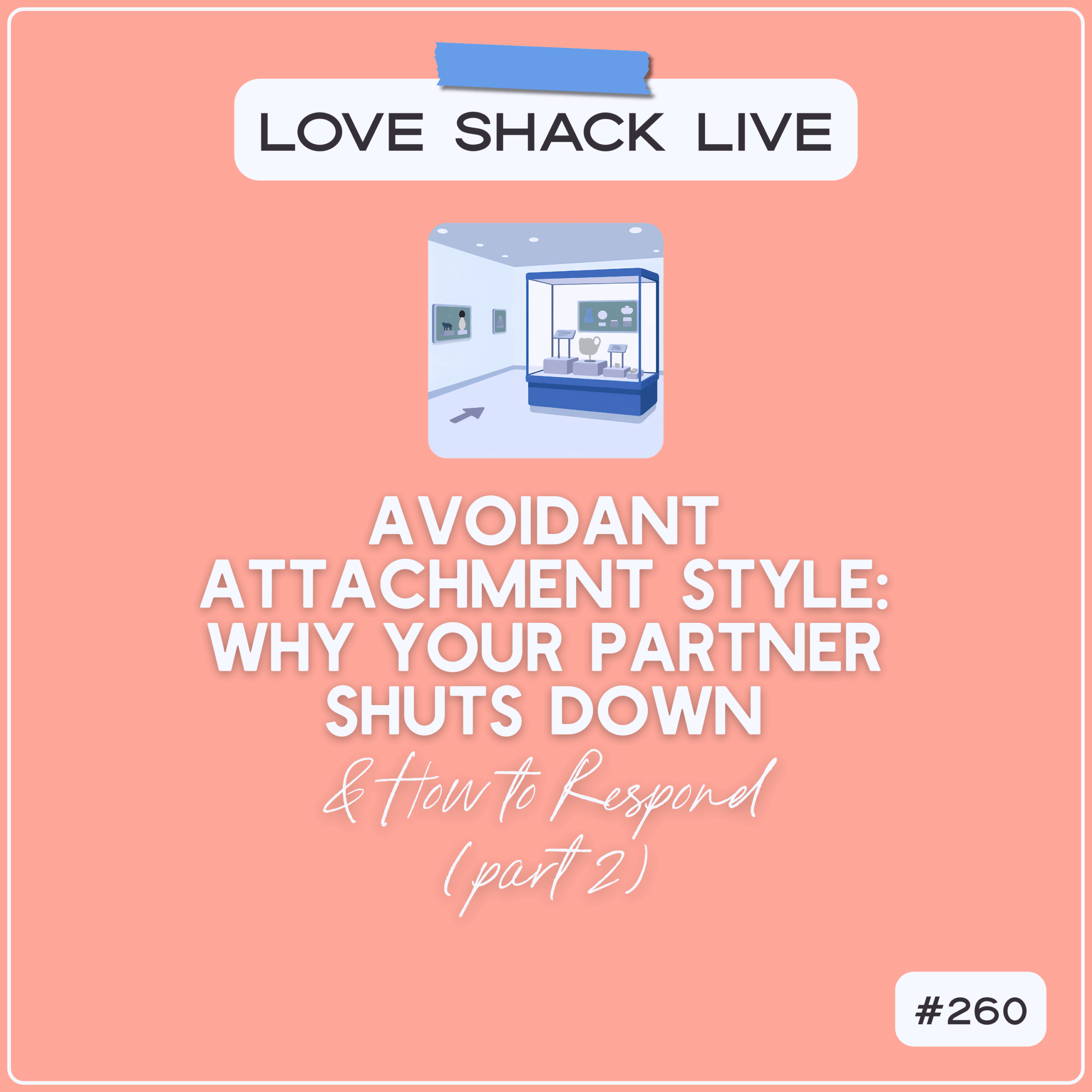
But on Episode 260 of Love Shack Live, we’re offering something different. And we share a metaphor that reframes the entire avoidant-anxious dynamic, not around what you’re saying, but around what listening actually requires.
The museum.
What Avoidant Attachment Actually Looks Like From the Inside
Here’s what most partners of avoidant attachment people get wrong: they assume the shutdown is about them. That the silence means ‘I don’t love you’ or ‘I don’t care.’ That the withdrawal is a choice, a punishment, a passive-aggressive strategy.
It’s not. Avoidant attachment is a nervous system response, a protection strategy learned early that says: closeness is risky, vulnerability is dangerous, and the safest thing I can do when emotions run high is create distance.
When a person with avoidant attachment finally does open up, when they lower the drawbridge and begin to share what’s actually happening inside them, that is not a small thing. That is enormous. That cost them something to do.
They are, in Staci’s words, giving you a tour of their museum.
The Museum: Every Person’s Inner World
Inside every person is an internal museum. A room where the scary things live. A room filled with their most treasured hopes… the ones so tender they’ve never been spoken out loud. A wing under construction. A hallway of question marks. And a few corners so private they’ve never let anyone in.
When your partner with avoidant attachment begins to share, even hesitantly, they are walking you through that space. Showing you what it looks like to be them.
And what happens if you criticize what’s on the walls? If you rush through, correct the narrative, or demand more than they’re ready to give? (This can happen in reverse too… the avoidant partner may be getting a tour of the anxious partner’s museum, and they can shut down, go quiet, or inadvertently dismiss some of the ‘installations’ they don’t understand.)
Either way, the result is the same: you get escorted out. The museum closes. And once that trust is broken, it can take a very long time to reopen.
How Anxious Attachment Partners Barge In Without Knowing It
This is the part that lands hardest for anxious attachment partners. And it’s worth sitting with.
The anxious drive to get in, to understand, to connect, to make sure everything is okay, feels like love. It is love. But when it comes out as pressure, urgency, emotional demands, or forcing a conversation the avoidant partner isn’t ready for, it doesn’t feel like love to them. It feels like an invasion.
As Brooke put it in the episode: looking back on her own anxious attachment patterns, she realized she had thrown bricks through the windows and broken in… absolutely convinced she was doing the right thing. That getting in there was the only way through.
But for a person with avoidant attachment, being broken into doesn’t create connection. It creates a reason to board up every window. To take down the sign. To make sure that never happens again.
The museum closes. Sometimes permanently.
The Listening Self-Check: Are You Actually Ready to Enter?
Before you can honor someone with avoidant attachment by truly listening to them, there’s one honest question to ask yourself first: Am I actually in a place right now where I can receive this?
Real listening, especially in avoidant-anxious relationships, requires emotional capacity. It requires you to hear things you disagree with, things that sting, things that don’t match your version of events, and stay curious instead of reactive. To hold the tension without rushing to resolve it.
That takes energy. Real energy. And if you’re already flooded, if your own anxious attachment system is activated, or you’re exhausted, or you’re carrying something heavy from earlier in the day, you don’t have the bandwidth to actually be in the museum. Not in a way that’s safe for either of you.
If that’s where you are, say so. But say it with care:
“I would love to understand more about this. I want to be honest… I’m not in a place right now where I can fully take it in, and I really want to be present for you when we go there. Let me take a little time, and I’ll come back to you.”
That’s not avoidance. That’s a person with self-awareness choosing to show up well rather than showing up reactively.
Understanding Is Not Agreement… And This Distinction Changes Everything
One of the biggest blocks in avoidant-anxious dynamics is a misunderstanding about what listening actually requires. Many anxious attachment partners believe that if they really let in what their avoidant partner is saying, they’re somehow endorsing it. Agreeing with it.
They’re not.
You can fully understand your partner’s experience, follow the thread of it all the way through, see exactly how it makes sense given what they believe and what they’ve been through, and still hold your own truth. Still see things differently. Still disagree.
Understanding is not agreement. It’s empathy. And in avoidant-anxious relationships, empathy is the one thing that actually keeps the door open.
The more a person with avoidant attachment feels genuinely understood, not pushed, not judged, not rushed, the more the museum opens. The more they share. The more both partners slowly, carefully, begin to actually see each other.
How to Get a Partner With Avoidant Attachment to Come to the Table
This is the question every anxious attachment partner eventually asks: okay, but how do I actually get them to talk to me?
The answer is counterintuitive: give them genuine permission not to.
When a partner with avoidant attachment feels like they have no choice… like showing up is mandatory, like saying no will result in conflict or withdrawal of affection, that’s not an invitation. That’s control. And control triggers avoidant shutdown faster than almost anything.
A real invitation looks different. It says: I would love to talk about this with you. Here’s what I’m hoping we can explore together. And I genuinely mean it when I say you can say no.
Without pressure, the avoidant partner has nothing to resist. And without resistance, showing up becomes possible.
The Pause Button: An Avoidant-Anxious Couple’s Best Tool
Even with all the right intentions, conversations between avoidant and anxious attachment partners can escalate. The anxious partner gets activated. The avoidant partner starts to shut down. And without an agreed-upon mechanism to pause, the conversation doesn’t stop, it crashes.
Staci and Tom recommend every couple create a shared pause phrase in advance: something both partners agree signals ‘I need a moment, and this is not rejection.’
Some options from the episode: ‘System overload.’ ‘I’m buffering.’ ‘Can we land this plane?’ ‘Red light.’ ‘I need snacks and oxygen right now.’
The specific phrase matters less than the shared agreement. A pause phrase gives the avoidant partner an exit that doesn’t feel like abandonment, and gives the anxious partner a signal that this is a pause, not a shutdown.
Avoidant Attachment Is Not a Life Sentence
Staci closed the episode with something important: avoidant attachment is a learned protection strategy. It is not a character flaw. It is not who someone is.
Partners with avoidant attachment want connection. They need it, the same as anyone. They just haven’t yet found a way to reach for it that feels safe.
The skills covered in this series: real listening, the self-check, creating safety, honoring the museum, these are the building blocks that make connection possible for avoidant and anxious partners alike. Not by becoming different people, but by learning a different way to move toward each other.
Part 3 is coming. There’s more to say, and more to learn.
Ready to understand your own attachment patterns and start building new skills?
Book a free Clarity Call with Tom: a real, no-pressure conversation to help you understand what’s actually happening in your relationship and which skills would make the biggest difference. Schedule yours at: stacibartley.com/apply
And if you and your partner are ready for something immersive: six days in Tuscany at a 1,000-year-old castle, working with Staci alongside six other couples… the Stirring Up Love Couples Retreat is one of the most powerful thing we offer. Registration closes March 1.
Learn more here: stacibartley.com/couples-retreat