

There’s a particular kind of loneliness that happens inside a relationship, not outside of it. You still share a home, a bed, a life. But somewhere along the way, you stopped really talking. The logistics still happen. Who’s picking up the kids, what’s for dinner, did the bill get paid. The real things don’t. The thoughts and feelings you used to share without a second thought now get held back. You measure your words. You wait for a better moment that never quite comes.
If that sounds like your relationship, you may have already decided what it means. Something is wrong with you. Or something is wrong with your partner. Or maybe the whole relationship was a mistake.
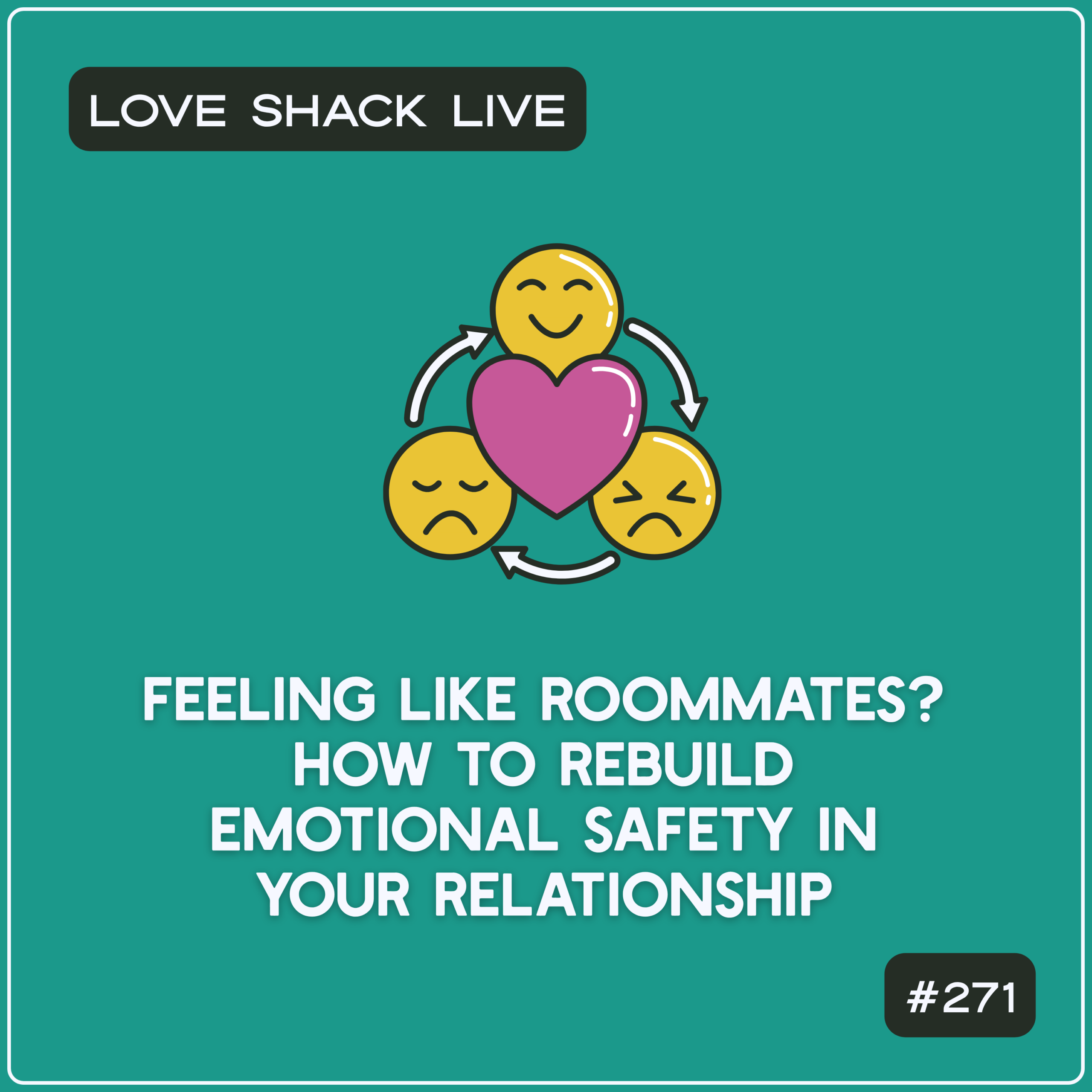
But there’s another explanation, and it’s the one Tom, Brooke, and I explore in this episode of Love Shack Live. What’s missing usually isn’t love. It’s emotional safety, and almost nobody was ever taught how to notice it, protect it, or build it back.
In this post I’ll walk you through what emotional safety actually is, how it erodes in small and almost invisible ways, what happens to a relationship when it runs out, and how any willing couple can rebuild it.
What Is Emotional Safety in a Relationship?
Emotional safety is the felt sense that you can share your real thoughts and feelings with another person and be met, rather than punished. It lives inside you. When it’s present, you feel open to sharing, and you’re willing to risk saying something even when you’re not sure how it will land.
It also builds on itself. When you take a small risk and it goes well, you risk a little more. The way I explain it: if I was safe telling you this, then I’m going to be safe telling you a little bit more. Trust grows one successful risk at a time.
That’s why I call emotional safety the building block of every emotional relationship. Communication, repair, intimacy, and connection all need somewhere stable to stand. Emotional safety is that ground.
Why You and Your Partner Stopped Talking
Here’s the part most couples never hear: you probably didn’t stop talking because you ran out of things to say. You stopped because it no longer feels safe to say them.
When emotional safety is low, the human response is to protect yourself. You give the surface. You go along to get along. And no amount of belittling, criticizing, badgering, begging, or pleading can pull honesty out of someone who doesn’t feel safe. Pushing usually makes it worse. The harder one partner pushes for “just tell me how you feel,” the more the other clamps down.
It shows up in the small things too. Your partner stops telling you about the interesting moment in their day, not because nothing happened, but because they don’t expect a meaningful response. Over time, the silence isn’t the problem. It’s the symptom.
How Emotional Safety Quietly Erodes
Emotional safety is rarely lost in one dramatic event. It drains away through small, often unintentional breaches. Anytime someone feels shut down, dismissed, belittled, criticized, blamed, or ignored, a little safety leaks out.
I use a vivid picture for this. Imagine throwing a glass against the wall. It shatters. Your partner gets upset and throws one back. On it goes, and the shards pile up. Years later, you’re living in a relationship that has become difficult and even dangerous to walk through, and you can’t quite remember when the floor stopped being clear.
Part of why this happens is that we believe we’re entitled to it. If you hurt my feelings, the unspoken logic goes, I get to hurt you back. Most of us were never taught anything different. We learned to “do relationships” from family, culture, and habit, often from a place of power, control, and trying to win.
The Two Ways We Protect Ourselves: Control and Collapse
When emotional safety is gone, most of us reach for one of two tools.
Collapse looks like shutting down, going quiet, and trying to escape the conversation. Control looks like attacking, escalating, and trying to shut the conversation down by force.
Neither is a character flaw. Both are emotional survival mode. The problem is that survival mode keeps the real conversation from ever happening, and the distance keeps growing.
“Unhappiness is trading what I want most for what I think I want in the moment.”
In a heated moment, what you think you want is to be right, to win, to make your partner feel what you feel. What you want most is to feel close, connected, and open with them. Emotional safety is the practice of noticing that trade before you make it.
What Happens When Emotional Safety Runs Out
When there’s none left, “co-creation” stops. You can still look fine from the outside. You split the bills, divide the chores, show up to dinner with friends. But emotionally, there’s no connection, little intimacy, and a quiet loneliness that follows you even when you’re in the same room.
In a word: you become roommates.
This same pattern plays out with children, especially teenagers. A parent who felt deeply connected to a child at six or eight can feel shut out at sixteen. The relationship didn’t fail. The emotional safety simply wore down without anyone naming it.
Can Emotional Safety Be Rebuilt? Yes, Here’s How
The good news is clear: if both people are willing to do their part, emotional safety can absolutely be rebuilt.
I compare it to inflating a balloon. The first few breaths are the hardest, and it feels like nothing is happening. Then it gets easier. Once it’s full, it’s simple to maintain with a little attention and the occasional top-up of air. But the moment you let go, the air rushes out fast, and you’re back near the beginning.
Two things make this picture hopeful. First, if the balloon deflates, starting again is easier than the very first time, because you’ve done it before. Second, you don’t have to let it deflate completely. You can learn to catch it, to notice safety slipping in the moment, and add a little air back before everything is lost.
Rebuilding rests on a few practices:
- Permission. This is the heart of emotional safety. Not permission to tolerate anything, but permission for each of you to feel what you feel and think what you think, even when those things differ. The conversation becomes, “This is what I’m thinking and feeling. What are you thinking and feeling?”
- Understanding before reacting. When your partner says something hard, the skillful response is, “That’s really hard to hear, but tell me more. Help me understand where you’re coming from.” Permission is the direct opposite of defensiveness and manipulation.
- Small, repeated risks. Safety rebuilds the way it was built the first time, through small risks that go well, again and again.
- Emotional pushups. Staying present and non-defensive in a hard conversation is a skill, and skills grow with practice. Expect to get it wrong sometimes. Messes are part of being human. What matters is learning to clean them up.
Why We Hurt the People We Love the Most
One of the ideas I most want you to sit with is polarity, the way a strength can quietly become a weakness.
In the beginning, your partner is where you feel safest in the whole world. That’s beautiful. But it also means they become the place you unload your stress, your frustration, and your pain. Ironically, taking your hurt out on the safest person slowly dismantles the very safety that made them feel safe in the first place.
The people you love most are the ones to handle with the most care, not the least.
A Simple Practice to Rebuild Connection This Week
Reconnection doesn’t always require a hard conversation. Sometimes it starts with being seen. Here’s the “This Is What I See” exercise I share in this episode.
Scroll through your photos and choose a few images of your partner that capture the qualities you love most. Send each one with a short note describing what you see. If it helps, crop your partner’s face out of group photos so the focus is fully on them.
Copy-and-paste starters:
- “This is what you look like when you listen to me. You’re so good at that.”
- “This is what you look like when you put me in my place when I need it most. It always makes me feel safe.”
- “This is what you look like through my eyes when I feel how much you love me.”
- “This is what you look like when you’re happy, blissed out, joyful, and a little quirky.”
It’s a meaningful gift for a partner, and just as powerful for a child or close friend. We all want to be seen, valued, and appreciated, and we rarely get to be.
Key Takeaways
- Emotional safety is the felt sense that you can share your real thoughts and feelings without being punished for it.
- Couples usually stop talking because it stopped feeling safe, not because they stopped caring.
- It erodes through small, often unintentional moments of feeling dismissed, criticized, or ignored.
- When it’s gone, couples drift into a transactional, roommate-style relationship.
- It can be rebuilt by any willing couple through permission, understanding, and small repeated risks.
- The people you love most deserve the most care, not the least.
Frequently Asked Questions About Emotional Safety
What is emotional safety in a relationship? Emotional safety is the felt sense that you can share your real thoughts and feelings with another person without being shut down, criticized, dismissed, or punished. When it’s present, you’re willing to risk being honest, and as those risks go well, you open up more over time.
Why don’t my partner and I talk anymore? Most couples stop talking not because they’ve run out of things to say, but because it no longer feels safe to say them. After repeated moments of feeling belittled or ignored, the brain protects itself by shutting down or attacking. The silence is a symptom of missing emotional safety.
Can emotional safety be rebuilt once it’s gone? Yes. With willingness from both partners, consistent practice, and a focus on understanding and permission rather than blame, emotional safety can be restored even after years of disconnection. It rebuilds the way it was first built: through small risks that go well, repeated over time.
What does it mean to feel like roommates in a marriage? When emotional safety drains away, emotional “co-creation” stops. Partners may still share chores, finances, and a calendar while feeling lonely and disconnected. Feeling like roommates is one of the clearest signs that emotional safety needs rebuilding.
Why do we hurt the people we love the most? Early in a relationship, your partner is where you feel safest, so it becomes the place you unload your pain. Over time, taking your hurt out on the person closest to you dismantles the very safety that made closeness possible.
How do you stop walking on eggshells in a relationship? Walking on eggshells signals low emotional safety. It begins to shift when both partners practice permission, allowing each person to think and feel differently without attack or defensiveness, and rebuild trust in small, repeatable steps rather than demanding instant change.
Take the Next Step
This conversation goes deeper than any blog post can. If you haven’t yet, press play on the full episode at the top of this post. Tom, Brooke, and I walk through the balloon metaphor, the role of permission, and an honest, vulnerable story Brooke shares from her first marriage about what can dismantle emotional safety in a single moment.
Wondering where your own relationship stands right now? Take the free Better Love Quiz. In just a few minutes it walks you through the real skills that keep love steady — knowing yourself, staying grounded when triggered, holding boundaries, communicating clearly, and repairing after conflict — and shows you where you’re strong, where the strain is coming from, and what kind of support would help you most.
To go further, the Better Love Club is where couples practice these skills with live guidance. You can learn more right here on the site.
So much of the struggle comes from simply not knowing where to start. This is an honest, pressure-free place to begin.