

Am I Stuck With My Attachment Style Forever?
Picture two people in a small boat when it starts rocking hard.
One of them grabs the other person. Grips their arm, says their name, wants to be held onto.
The other one grabs the rail. Plants their feet, goes quiet, looks straight ahead and says nothing at all.
From the outside, those look like two completely different people. One of them clearly cares. The other one looks cold.
But they are both terrified of the exact same thing, which is going into the water.
That’s anxious and avoidant in about ten seconds, and it’s most of what I want you to understand before you decide anything about your partner.
The part almost everybody gets wrong
Our comment section is full of people talking past each other on this. The anxious folks describe avoidant partners as cold, uncaring, checked out, capable of walking away without a second thought. The avoidant folks describe anxious partners as smothering and impossible to satisfy.
Here’s what I want to offer you instead.
The anxious person is saying come closer so I know we’re okay. The avoidant person is saying let me get some room so I can feel steady. Those are opposite behaviors. They are not opposite emotions. Underneath both of them is the same fear, which is that this thing you’ve built together might not hold.
The anxious person says it out loud. The avoidant person does not. And because they don’t say it, we decide they aren’t feeling it.
They’re feeling it. In our house, the quiet one has told me since that he was in more pain during his silence than I was during all my talking. I just couldn’t see it, because there was nothing to see.
If you take one thing from this, take that. Silence is not the absence of feeling. Sometimes it’s the whole storm, with the windows closed.
Your attachment style is not who you are
Somewhere along the way this work turned from a window into a wall.
Attachment theory came out of real research, going back to John Bowlby in the 1930s and later Mary Ainsworth, and it was built to help us see what’s happening inside us when connection feels threatened. It was meant to open something up.
Now people take a quiz, get a result, and move into it like a permanent address. He’s avoidant, so this is hopeless. I’m anxious, so this is just who I am.
I want to say this slowly, because it took me years to land on it.
Your attachment style is not who you are. It’s an experience you are having.
It’s a description of how you happen to be coping right now, under this much pressure, in this particular relationship, at this point in your life. It is not your character, and it is certainly not your ceiling.
I know that firsthand. There was a stretch of about ten years, before Tom, when I was the avoidant one. Fully. On purpose. I could give you the exact reasons why, and I do in the episode. Then I met him, and I wanted it to work badly enough that I found myself right back in anxious. Same woman. Same history. Completely different style, because the circumstances were different and what was at stake had changed.
So when somebody asks me whether people can change their attachment style, the honest answer is that most of us already have, more than once, and nobody pointed it out at the time.
What we get into in the episode
Understanding this is the easy part. Doing something with it while you’re in it is another thing entirely.
So in this conversation we cover:
- Why anxious and avoidant people find each other so reliably. There’s a specific reason each one is magnetic to the other, and I think you’ll recognize it immediately.
- What actually happens in the loop when one person starts reaching and the other starts pulling away, and why both people are doing something that makes complete sense from the inside.
- The story Tom and I have never told on this show, about a season when he pulled away, I chased, and space became a very real conversation between us. He talks about what was going on during that silence.
- Your questions: breadcrumbing, how to meet an avoidant partner in the middle, and why it can feel like the whole job lands on the anxious person.
- Four sentences you can use when someone you love has gone quiet on you. They take about ten seconds to say. What you do right after you say them is the harder part, and that’s the part we spend time on.
We also point you toward the original attachment questionnaire, rather than one of the many copies of copies going around, so you can start from the actual source.
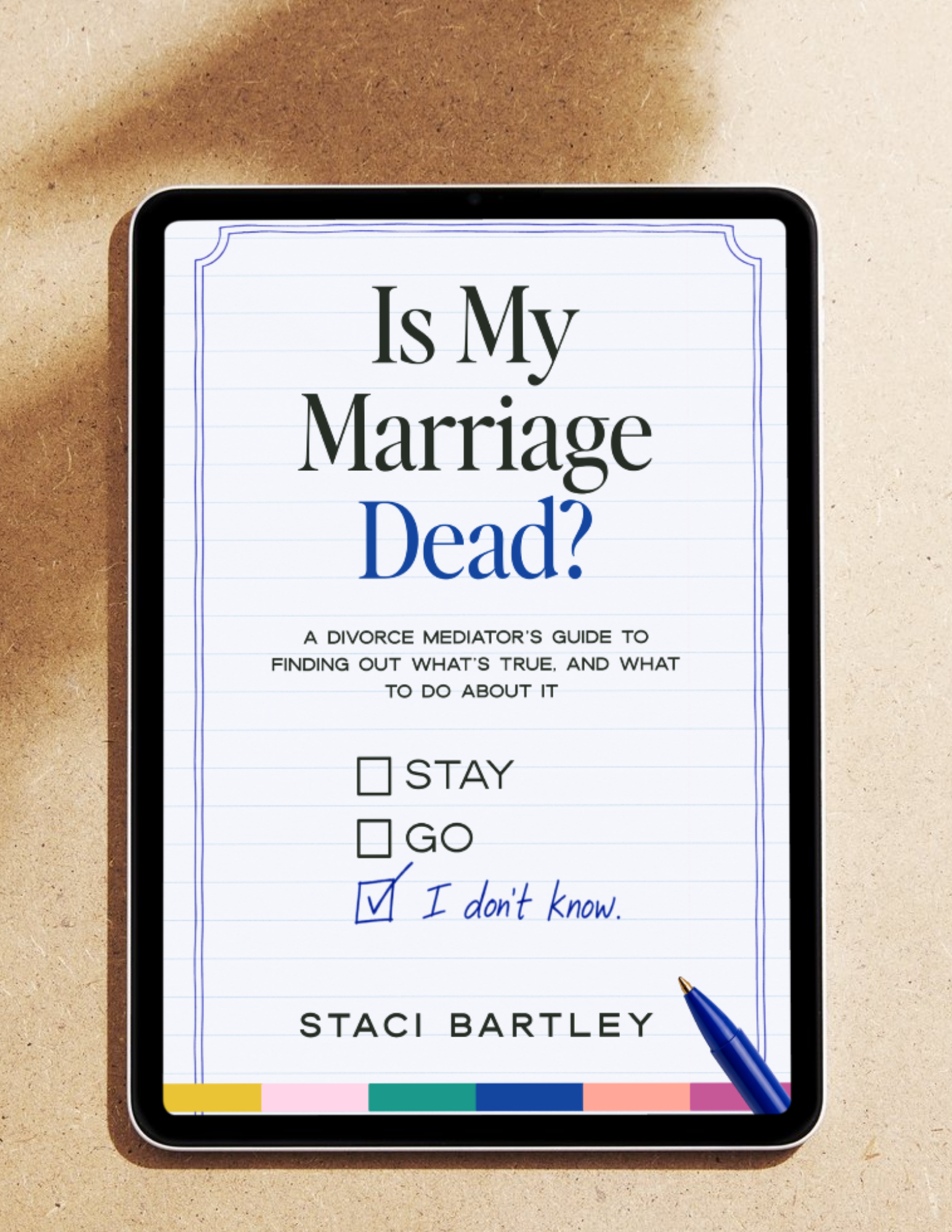
Is My Marriage Dead?
Stuck is not the same as over.
If you’ve been quietly asking whether what’s happening at home is a rough patch or something more serious, this is the book I wrote for you.
It won’t tell you to stay. It won’t tell you to leave. It helps you figure out what you’re actually looking at.
There are questions and worksheets throughout, and you don’t need your partner to participate for you to begin.
Digital book · $9 · Start reading today
GET THE BOOK →
If you’d rather start somewhere free, take the Better Love Quiz. Twenty-two questions, about five minutes, and an honest read on whether this is a rough patch or real trouble. Completely private. Only you see your results, and your partner is never contacted.
One last thing, and it’s where I’d leave you.
Secure attachment is not an address you arrive at. It’s somewhere you travel toward, lose your footing near, and head back to again. If you aren’t there yet, you aren’t behind. You’re on the road, the same as the three of us.
Love isn’t enough, but skills are. Learn them, practice them, and live them today.